Showing posts with label Christian hermeneutics. Show all posts

Saturday, November 21, 2015

Do not neglect to show hospitality to strangers, for thereby some have entertained angels unawares.


Irish Immigrants coming to America 


I am re-visiting Hebrews 13:2 as the United States plunges once again into anti-immigration hysteria in the name of a Christianity that in reality ALWAYS called for inclusion of all marginalized people.  After the attacks in Paris last week, and despite the ongoing media denial about attacks in places like Nigeria and Lebanon, the fascists of America are calling for the end of Syrian immigration, the registration of Muslims in the US, and closing Muslim places of worship.  This intense fascist exploitation of the tragedies in Paris is typical for the right wing in America - and that is right wing politicians, who continue to harness Christian prejudice despite the fact that Christianity in its roots was not anti-immigrant.

Hebrews 13:2 is a beautiful passage from Jewish Scripture.  "Do not neglect to show hospitality to strangers, for thereby some have entertained angels unawares."  While keeping Jewish teaching, in Christian Scripture, Jesus came as a new law, calling for people to join together in the name of Christ, not in the name of any one nation or one empire.  Governments of the day were astounded and threatened when slaves and masters, Jews and Romans, people of Palestine and people of Greece and people of Egypt gathered together to worship in a new community.  If you read my blog at all you know I have posted about Coptic polytheism in early Christian worship, about Paganism in both early Hebrew and early Christian communities, about open communion in Christian worship, about the importance of extending a shared worship to all peoples and from all peoples.

I have also been thinking this week about my many Muslim friends here in the United States.  Sasha and Saheim are goddaughter and friend, both born in the US, and both Muslim.  Sasha babysat my daughter for years, after I babysat for her years before.  Saheim befriended me and my daughter at a convention in his hometown, and continues to show the hospitality of Islam in his every action and gesture of friendship to me and my teen.  One of my greatest teachers, Mark, another US citizen, taught Islamic thought in his business classes, encouraging students of every faith to see the connection between business and spirituality.  And I have known immigrants, and been the better because of them.  Growing up, Noor was a visiting scholar from Egypt, who sat threw many high school classes with me while her parents studied in my hometown University.  Later, Ayesha was a family friend, also studying here in the States, whose family embraced me and my children with special needs when many Christian Americans would not.

Islam is part of American life, from my family and friends, to the Rumi poetry I read daily on Facebook, to the Mosque in Pittsburgh that gave out food weekly to the poor.  When fascist politicians talk of registering Muslims, they are talking of American citizens, of visiting children and scholars, of refugees and of highly skilled immigrants.  I am seeing many, many articles calling on Americans to welcome Syrian immigrants, and to stand against anti-Islamic rhetoric.  But I want us to remember that most of already know Muslims, and that the Islamic communities of America are already integral to our lives.

Bridget's Fire has long been a blog about women and religion, from puja and Hindu traditions, to Christian theology, to Jewish and Pagan traditions.  I need to be more purposeful in including Muslim feminisms, Muslim spirituality, and the centuries-old traditions of Muslim hospitality and political activism for peace and justice.

But today I am invoking Hebrews.  The passage:  Do not neglect to show hospitality to strangers has deep roots in Western tradition.  Hospitality was central to the Bridget community in Christian Ireland, with open doors to all visitors.  Indeed, hospitality to strangers was a sacred value throughout Wales, Scotland and Ireland.  Celtic Christianity developed around monasteries, so the Christian believer in early Celtic lands had to travel to learn, to study, to pray.  Travelers required a welcome, and hospitality to a stranger became a cornerstone to early Celtic Christian thought.

The blog Godspace:  Spirituality, Sustainability, Creativity, offers a wonderful liturgy of Celtic Christian hospitality traditions.  They include the following traditional prayer:

We saw a stranger yesterday, we put food in the eating place,
Drink in the drinking place, music in the listening place,
and with the sacred name of the triune God,
He blessed us and our house, our cattle and out dear ones.
As the lark says in her song:  Often, often, often goes the Christ in the stranger's guise.

I invite all my readers, of any faith or none, to find ways to act in hospitality as a counter to the fascism surrounding us in the United States.  I also invite us to acknowledge and share the importance of our Muslim friends, family and neighbors, of Islamic traditions that shape our lives, of the importance of both American Muslims and immigrants of all faiths in the open table of hospitality that should be America.


Monday, July 6, 2015

Bridget Foster Mother

St. Bridget Spreads Her Cloak over Ireland by artist Cynthia Matyi


As an adoptive mom I have long identified with the the Christian Bridget's role as foster mother.

Medieval legend goes that Bridget, the goddess of welcoming hospitality, was at the inn where Joseph and Mary stopped - only to be shocked when they were shuffled off to the stables.  Bridget worried about the young couple,  having been magically whisked there from the shores of the Irish Sea.  In this aspect, Bridget is Miome Chriosde, midwife to Christ, banchuideachaidh Moire, aid-woman to Mary.  In the Scottish Highlands version, she sees a lamp in the stable and goes to help deliver baby Jesus.  In multiple Irish and Welsh tales, she is Christ's later foster mother, a hugely important role in medieval Ireland and Wales, where foster mothers took on the education of their foster child at the age of seven.  In these stories, Bridget becomes a sacred teacher in the medieval tradition, guiding her foster child into apprenticeship and miraculous career.  Dennis O'Neal in Passionate Holiness:  Marginalized Christian Devotions for Distinctive Peoples notes that no other non-Biblical Saint has been connected to both Jesus and Mary as Bridget has.

Since I've been a mom, I've lived in a different culture, one quite uncomfortable with foster parenting and adoption.  Common questions I've heard over the years include, "where did you buy your children?" and "are those kids really yours?" and "don't they want their real mothers?"  At the same time, schools have refused to enroll my daughter, lawyers told me I would never get custody of my children during my divorce, and even old friends from church questioned if I had a right to parent as a single mom after the divorce.  "It's not like they're really your children," said one Christian friend.  The sacredness of Bridget, as Christ's foster mother, is lost in modern America.

Now with two college kids on my hands, and one high schooler, the questions over the years are somewhat moot.  My kids can tell you who I am, that annoying person insisting they do homework and finish semesters.  Their friends think my dreds are cool and I am all together an embarrassment.  Proof of real motherhood if there ever was one!

But in my work in West Virginia, I am often solving one crisis after another.  As schools around the country become increasingly punitive, sending kids with special needs to juvenile detention and foster care is more and more common.  The same schools refuse federally mandated special education programs, and blame parents when children don't want to attend school.  At the same time, I drive up hollows to rural areas where no other service provider will go, working with wonderful children whose only crime is living too far off of main roads.  I am not a foster mother to these children and teenagers in the modern sense, but I am often working to secure safe and nurturing education and services for babies, preschoolers, kids and teenagers.  Along the way I have made some wonderful connections to so many families.  I love parents in West Virginia who work their asses off to get the best for their children that they can.

So in that sense I feel like Bridget foster mother.  From playing with a ten month old who is suspected of being on the autism spectrum, to coaxing a bullied teen with asperger's out of bed, I am working with kids who need someone who is professional and can advocate for them and for their parents.  Most of my work days I see amazing changes every single visit:  the ten month old smiles when I coo in her face; the teen sits up and talks about archery; the parents who worried about their children laugh and cry to see their kids learning and growing.  Watching families and kids change and relax and remember how to care for one another is a truly sacred experience.  

I remember back in the dark days when I started my counseling program, and again when I worked in crappy internships with punitive supervisors who had no idea how to play and teach real children.  It was scary to think that to support my own adopted kids I had to work in programs that mostly harmed kids.  I wanted so much to somehow continue giving other children and teens the freedom and support I give my own.  The professional world seemed stacked against me.

Sometimes I really did wonder if Bridget had somehow forgotten me, our contracts, my puja.  Or maybe she was busy with others, and had no more time to follow my little problems.

But now I feel awed and amazed at my work, and I can see Bridget the foster mother to Jesus in the lives I am touching.  I can name teenagers who are not in jail because of my reports, count toddlers who never talked who are now talking, list children who had no accommodations in school who now have supports.  I have helped families get better services, helped new kids start homeschooling, and helped other kids find better schools.  In Celtic society, a foster mother helps guide a child into apprenticeship and vocation, and I am helping kids make eye contact, speak, study things they love, and get everything from computers in their schools to parents who allow them their video games.  A teenager with greasy hair who makes eye contact and smiles and thanks me for having their video games back is a sacred thing, too.

So, I feel a lot of gratitude for Bridget.  Maybe she was busy with others while I suffered through my internships.  Maybe she did forget me while I was busy studying for certification exams that seem endless.  (One more in August.)  But somehow, all that difficult time led to doing this work now.  Dirt roads and nasty schools and isolated hollows and sacred children, sacred families, and the sacred work of protecting and mentoring children.

May the blessings of Bridgid the bright
Rest upon us, this day, this night,
I will kindle this fire as Bridghid, foster mother of Christ would
The Foster Mother's Name be on our hearth
Be on our work, be on our households all.

(Carmina Gadelica, Carmichael, 1900)


Friday, May 27, 2011

Awesome article on Women in Early Christianity


This is such an awesome article I want to include it here on my blog: Dive in and enjoy!

I've included links to primary resources like The Gospel of Mary and Thunder Perfect Mind: check 'em out!

Women In Ancient Christianity: The New Discoveries
Scholar Karen King examines the evidence concerning women's important place in early Christianity. She draws a surprising new portrait of Mary Magdalene and outlines the stories of previously unknown early Christian women.

by Karen L. King
Karen L. King is Professor of New Testament Studies and the History of Ancient Christianity at Harvard University in the Divinity School. She has published widely in the areas of Gnosticism, ancient Christianity, and Women's Studies.

In the last twenty years, the history of women in ancient Christianity has been almost completely revised. As women historians entered the field in record numbers, they brought with them new questions, developed new methods, and sought for evidence of women's presence in neglected texts and exciting new findings. For example, only a few names of women were widely known: Mary, the mother of Jesus; Mary Magdalene, his disciple and the first witness to the resurrection; Mary and Martha, the sisters who offered him hospitality in Bethany. Now we are learning more of the many women who contributed to the formation of Christianity in its earliest years.

Perhaps most surprising, however, is that the stories of women we thought we knew well are changing in dramatic ways. Chief among these is Mary Magdalene, a woman infamous in Western Christianity as an adulteress and repentant whore. Discoveries of new texts from the dry sands of Egypt, along with sharpened critical insight, have now proven that this portrait of Mary is entirely inaccurate. She was indeed an influential figure, but as a prominent disciple and leader of one wing of the early Christian movement that promoted women's leadership.
--------------------------------------------

Certainly, the New Testament Gospels, written toward the last quarter of the first century CE, acknowledge that women were among Jesus' earliest followers. From the beginning, Jewish women disciples, including Mary Magdalene, Joanna, and Susanna, had accompanied Jesus during his ministry and supported him out of their private means (Luke 8:1-3). He spoke to women both in public and private, and indeed he learned from them. According to one story, an unnamed Gentile woman taught Jesus that the ministry of God is not limited to particular groups and persons, but belongs to all who have faith (Mark 7:24-30; Matthew 15:21-28). A Jewish woman honored him with the extraordinary hospitality of washing his feet with perfume. Jesus was a frequent visitor at the home of Mary and Martha, and was in the habit of teaching and eating meals with women as well as men. When Jesus was arrested, women remained firm, even when his male disciples are said to have fled, and they accompanied him to the foot of the cross. It was women who were reported as the first witnesses to the resurrection, chief among them again Mary Magdalene. Although the details of these gospel stories may be questioned, in general they reflect the prominent historical roles women played in Jesus' ministry as disciples.

WOMEN IN THE FIRST CENTURY OF CHRISTIANITY

After the death of Jesus, women continued to play prominent roles in the early movement. Some scholars have even suggested that the majority of Christians in the first century may have been women.

The letters of Paul - dated to the middle of the first century CE - and his casual greetings to acquaintances offer fascinating and solid information about many Jewish and Gentile women who were prominent in the movement. His letters provide vivid clues about the kind of activities in which women engaged more generally. He greets Prisca, Junia, Julia, and Nereus' sister, who worked and traveled as missionaries in pairs with their husbands or brothers (Romans 16:3, 7, 15). He tells us that Prisca and her husband risked their lives to save his. He praises Junia as a prominent apostle, who had been imprisoned for her labor. Mary and Persis are commended for their hard work (Romans 16:6, 12). Euodia and Syntyche are called his fellow-workers in the gospel (Philippians 4:2-3). Here is clear evidence of women apostles active in the earliest work of spreading the Christian message.

Paul's letters also offer some important glimpses into the inner workings of ancient Christian churches. These groups did not own church buildings but met in homes, no doubt due in part to the fact that Christianity was not legal in the Roman world of its day and in part because of the enormous expense to such fledgling societies. Such homes were a domain in which women played key roles. It is not surprising then to see women taking leadership roles in house churches. Paul tells of women who were the leaders of such house churches (Apphia in Philemon 2; Prisca in I Corinthians 16:19). This practice is confirmed by other texts that also mention women who headed churches in their homes, such as Lydia of Thyatira (Acts 16:15) and Nympha of Laodicea (Colossians 4:15). Women held offices and played significant roles in group worship. Paul, for example, greets a deacon named Phoebe (Romans 16:1) and assumes that women are praying and prophesying during worship (I Corinthians 11). As prophets, women's roles would have included not only ecstatic public speech, but preaching, teaching, leading prayer, and perhaps even performing the eucharist meal. (A later first century work, called the Didache, assumes that this duty fell regularly to Christian prophets.)

MARY MAGDALENE: A TRUER PORTRAIT

Later texts support these early portraits of women, both in exemplifying their prominence and confirming their leadership roles (Acts 17:4, 12). Certainly the most prominent among these in the ancient church was Mary Magdalene. A series of spectacular 19th and 20th century discoveries of Christian texts in Egypt dating to the second and third century have yielded a treasury of new information. It was already known from the New Testament gospels that Mary was a Jewish woman who followed Jesus of Nazareth. Apparently of independent means, she accompanied Jesus during his ministry and supported him out of her own resources (Mark 15:40-41; Matthew 27:55-56; Luke 8:1-3; John 19:25).

Although other information about her is more fantastic, she is repeatedly portrayed as a visionary and leader of the early movement.( Mark 16:1-9; Matthew 28:1-10; Luke24:1-10; John 20:1, 11-18; Gospel of Peter ). In the Gospel of John, the risen Jesus gives her special teaching and commissions her as an apostle to the apostles to bring them the good news. She obeys and is thus the first to announce the resurrection and to play the role of an apostle, although the term is not specifically used of her. Later tradition, however, will herald her as "the apostle to the apostles." The strength of this literary tradition makes it possible to suggest that historically Mary was a prophetic visionary and leader within one sector of the early Christian movement after the death of Jesus.

The newly discovered Egyptian writings elaborate this portrait of Mary as a favored disciple. Her role as "apostle to the apostles" is frequently explored, especially in considering her faith in contrast to that of the male disciples who refuse to believe her testimony. She is most often portrayed in texts that claim to record dialogues of Jesus with his disciples, both before and after the resurrection. In the Dialogue of the Savior, for example, Mary is named along with Judas (Thomas) and Matthew in the course of an extended dialogue with Jesus. During the discussion, Mary addresses several questions to the Savior as a representative of the disciples as a group. She thus appears as a prominent member of the disciple group and is the only woman named. Moreover, in response to a particularly insightful question, the Lord says of her, "´You make clear the abundance of the revealer!'" (140.17-19). At another point, after Mary has spoken, the narrator states, "She uttered this as a woman who had understood completely"(139.11-13). These affirmations make it clear that Mary is to be counted among the disciples who fully comprehended the Lord's teaching (142.11-13).

In another text, the Sophia of Jesus Christ, Mary also plays a clear role among those whom Jesus teaches. She is one of the seven women and twelve men gathered to hear the Savior after the resurrection, but before his ascension. Of these only five are named and speak, including Mary. At the end of his discourse, he tells them, "I have given you authority over all things as children of light," and they go forth in joy to preach the gospel. Here again Mary is included among those special disciples to whom Jesus entrusted his most elevated teaching, and she takes a role in the preaching of the gospel.

In the Gospel of Philip, Mary Magdalene is mentioned as one of three Marys "who always walked with the Lord" and as his companion (59.6-11). The work also says that Lord loved her more than all the disciples, and used to kiss her often (63.34-36). The importance of this portrayal is that yet again the work affirms the special relationship of Mary Magdalene to Jesus based on her spiritual perfection.

In the Pistis Sophia, Mary again is preeminent among the disciples, especially in the first three of the four books. She asks more questions than all the rest of the disciples together, and the Savior acknowledges that: "Your heart is directed to the Kingdom of Heaven more than all your brothers" (26:17-20). Indeed, Mary steps in when the other disciples are despairing in order to intercede for them to the Savior (218:10-219:2). Her complete spiritual comprehension is repeatedly stressed.

She is, however, most prominent in the early second century Gospel of Mary, which is ascribed pseudonymously to her. More than any other early Christian text, the Gospel of Mary presents an unflinchingly favorable portrait of Mary Magdalene as a woman leader among the disciples. The Lord himself says she is blessed for not wavering when he appears to her in a vision. When all the other disciples are weeping and frightened, she alone remains steadfast in her faith because she has grasped and appropriated the salvation offered in Jesus' teachings. Mary models the ideal disciple: she steps into the role of the Savior at his departure, comforts, and instructs the other disciples. Peter asks her to tell any words of the Savior which she might know but that the other disciples have not heard. His request acknowledges that Mary was preeminent among women in Jesus' esteem, and the question itself suggests that Jesus gave her private instruction. Mary agrees and gives an account of "secret" teaching she received from the Lord in a vision. The vision is given in the form of a dialogue between the Lord and Mary; it is an extensive account that takes up seven out of the eighteen pages of the work. At the conclusion of the work, Levi confirms that indeed the Saviour loved her more than the rest of the disciples (18.14-15). While her teachings do not go unchallenged, in the end the Gospel of Mary affirms both the truth of her teachings and her authority to teach the male disciples. She is portrayed as a prophetic visionary and as a leader among the disciples.

OTHER CHRISTIAN WOMEN

Other women appear in later literature as well. One of the most famous woman apostles was Thecla, a virgin-martyr converted by Paul. She cut her hair, donned men's clothing, and took up the duties of a missionary apostle. Threatened with rape, prostitution, and twice put in the ring as a martyr, she persevered in her faith and her chastity. Her lively and somewhat fabulous story is recorded in the second century Acts of Thecla. From very early, an order of women who were widows served formal roles of ministry in some churches (I Timothy 5:9-10). The most numerous clear cases of women's leadership, however, are offered by prophets: Mary Magdalene, the Corinthian women, Philip's daughters, Ammia of Philadelphia, Philumene, the visionary martyr Perpetua, Maximilla, Priscilla (Prisca), and Quintilla. There were many others whose names are lost to us. The African church father Tertullian, for example, describes an unnamed woman prophet in his congregation who not only had ecstatic visions during church services, but who also served as a counselor and healer (On the Soul 9.4). A remarkable collection of oracles from another unnamed woman prophet was discovered in Egypt in 1945. She speaks in the first person as the feminine voice of God: Thunder, Perfect Mind. The prophets Prisca and Quintilla inspired a Christian movement in second century Asia Minor (called the New Prophecy or Montanism) that spread around the Mediterranean and lasted for at least four centuries. Their oracles were collected and published, including the account of a vision in which Christ appeared to the prophet in the form of a woman and "put wisdom" in her (Epiphanius, Panarion 49.1). Montanist Christians ordained women as presbyters and bishops, and women held the title of prophet. The third century African bishop Cyprian also tells of an ecstatic woman prophet from Asia Minor who celebrated the eucharist and performed baptisms (Epistle 74.10). In the early second century, the Roman governor Pliny tells of two slave women he tortured who were deacons (Letter to Trajan 10.96). Other women were ordained as priests in fifth century Italy and Sicily (Gelasius, Epistle 14.26).

Women were also prominent as martyrs and suffered violently from torture and painful execution by wild animals and paid gladiators. In fact, the earliest writing definitely by a woman is the prison diary of Perpetua, a relatively wealthy matron and nursing mother who was put to death in Carthage at the beginning of the third century on the charge of being a Christian. In it, she records her testimony before the local Roman ruler and her defiance of her father's pleas that she recant. She tells of the support and fellowship among the confessors in prison, including other women. But above all, she records her prophetic visions. Through them, she was not merely reconciled passively to her fate, but claimed the power to define the meaning of her own death. In a situation where Romans sought to use their violence against her body as a witness to their power and justice, and where the Christian editor of her story sought to turn her death into a witness to the truth of Christianity, her own writing lets us see the human being caught up in these political struggles. She actively relinquishes her female roles as mother, daughter, and sister in favor of defining her identity solely in spiritual terms. However horrifying or heroic her behavior may seem, her brief diary offers an intimate look at one early Christian woman's spiritual journey.

EARLY CHRISTIAN WOMEN'S THEOLOGY

Study of works by and about women is making it possible to begin to reconstruct some of the theological views of early Christian women. Although they are a diverse group, certain reoccurring elements appear to be common to women's theology-making. By placing the teaching of the Gospel of Mary side-by-side with the theology of the Corinthian women prophets, the Montanist women's oracles, Thunder Perfect Mind, and Perpetua's prison diary, it is possible to discern shared views about teaching and practice that may exemplify some of the contents of women's theology:

* Jesus was understood primarily as a teacher and mediator of wisdom rather than as ruler and judge.
* Theological reflection centered on the experience of the person of the risen Christ more than the crucified savior. Interestingly enough, this is true even in the case of the martyr Perpetua. One might expect her to identify with the suffering Christ, but it is the risen Christ she encounters in her vision.
* Direct access to God is possible for all through receiving the Spirit.
* In Christian community, the unity, power, and perfection of the Spirit are present now, not just in some future time.
* Those who are more spiritually advanced give what they have freely to all without claim to a fixed, hierarchical ordering of power.
* An ethics of freedom and spiritual development is emphasized over an ethics of order and control.
* A woman's identity and spirituality could be developed apart from her roles as wife and mother (or slave), whether she actually withdrew from those roles or not. Gender is itself contested as a "natural" category in the face of the power of God's Spirit at work in the community and the world. This meant that potentially women (and men) could exercise leadership on the basis of spiritual achievement apart from gender status and without conformity to established social gender roles.
* Overcoming social injustice and human suffering are seen to be integral to spiritual life.

Women were also actively engaged in reinterpreting the texts of their tradition. For example, another new text, the Hypostasis of the Archons, contains a retelling of the Genesis story ascribed to Eve's daughter Norea, in which her mother Eve appears as the instructor of Adam and his healer.

The new texts also contain an unexpected wealth of Christian imagination of the divine as feminine. The long version of the Apocryphon of John, for example, concludes with a hymn about the descent of divine Wisdom, a feminine figure here called the Pronoia of God. She enters into the lower world and the body in order to awaken the innermost spiritual being of the soul to the truth of its power and freedom, to awaken the spiritual power it needs to escape the counterfeit powers that enslave the soul in ignorance, poverty, and the drunken sleep of spiritual deadness, and to overcome illegitimate political and sexual domination. The oracle collection Thunder Perfect Mind also adds crucial evidence to women's prophetic theology-making. This prophet speaks powerfully to women, emphasizing the presence of women in her audience and insisting upon their identity with the feminine voice of the Divine. Her speech lets the hearers transverse the distance between political exploitation and empowerment, between the experience of degradation and the knowledge of infinite self-worth, between despair and peace. It overcomes the fragmentation of the self by naming it, cherishing it, insisting upon the multiplicity of self-hood and experience.

These elements may not be unique to women's religious thought or always result in women's leadership, but as a constellation they point toward one type of theologizing that was meaningful to some early Christian women, that had a place for women's legitimate exercise of leadership, and to whose construction women contributed. If we look to these elements, we are able to discern important contributions of women to early Christian theology and praxis. These elements also provide an important location for discussing some aspects of early Christian women's spiritual lives: their exercise of leadership, their ideals, their attraction to Christianity, and what gave meaning to their self-identity as Christians.

UNDERMINING WOMEN'S PROMINENCE

Women's prominence did not, however, go unchallenged. Every variety of ancient Christianity that advocated the legitimacy of women's leadership was eventually declared heretical, and evidence of women's early leadership roles was erased or suppressed.

This erasure has taken many forms. Collections of prophetic oracles were destroyed. Texts were changed. For example, at least one woman's place in history was obscured by turning her into a man! In Romans 16:7, the apostle Paul sends greetings to a woman named Junia. He says of her and her male partner Andronicus that they are "my kin and my fellow prisoners, prominent among the apostles and they were in Christ before me." Concluding that women could not be apostles, textual editors and translators transformed Junia into Junias, a man.

Or women's stories could be rewritten and alternative traditions could be invented. In the case of Mary Magdalene, starting in the fourth century, Christian theologians in the Latin West associated Mary Magdalene with the unnamed sinner who anointed Jesus' feet in Luke 7:36-50. The confusion began by conflating the account in John 12:1-8, in which Mary (of Bethany) anoints Jesus, with the anointing by the unnamed woman sinner in the accounts of Luke. Once this initial, erroneous identification was secured, Mary Magdalene could be associated with every unnamed sinful woman in the gospels, including the adulteress in John 8:1-11 and the Syro-phoenician woman with her five and more "husbands" in John 4:7-30. Mary the apostle, prophet, and teacher had become Mary the repentant whore. This fiction was invented at least in part to undermine her influence and with it the appeal to her apostolic authority to support women in roles of leadership.

Until recently the texts that survived have shown only the side that won. The new texts are therefore crucial in constructing a fuller and more accurate portrait. The Gospel of Mary, for example, argued that leadership should be based on spiritual maturity, regardless of whether one is male or female. This Gospel lets us hear an alternative voice to the one dominant in canonized works like I Timothy, which tried to silence women and insist that their salvation lies in bearing children. We can now hear the other side of the controversy over women's leadership and see what arguments were given in favor of it.

It needs to be emphasized that the formal elimination of women from official roles of institutional leadership did not eliminate women's actual presence and importance to the Christian tradition, although it certainly seriously damaged their capacity to contribute fully. What is remarkable is how much evidence has survived systematic attempts to erase women from history, and with them the warrants and models for women's leadership. The evidence presented here is but the tip of an iceberg.

Read more: http://www.pbs.org/wgbh/pages/frontline/shows/religion/first/women.html#ixzz1NYe6tvNz

Wednesday, March 23, 2011

Goddess worship in Early Christian Community


Ok! Midterms are almost done, and time for a new post on archaeology and Goddess worship in early Christian community. Professor Arthur Segal first found images of Aphrodite in excavations in Israel in 2009. Excavations are at the roman village of Sussita, inhabited until an earthquake destroyed it in 749 c.e. Professor Segal was part of an American delegation uncovering the day to day homes of early Romans in the now Christianized empire. The discovery of Aphrodite figurines goes a long way to showing that early Christians maintained Goddess worship well into the Christian era.

Then this past September, archaeologists unearthed more Goddess worship evidence. In a wealthy home, Israeli and American archaeologists uncovered a wall painting of the city's patron deity, the Goddess Tyche. The same home held beautifully carved figures of Dionysus' companions, Maenads. The maenads appear to be dancing in the ecstatic dances associated with the cult to Dionysus.

Put together, these findings over several years offer modern women another model of Christianity, one that values female deity and completely different models of sexuality than often depicted in early Christian community. Maenads are about as far from religious celibacy as one can get! Yet here is Sussita, a Romano-Christian town with clear evidence of Goddess cult surviving alongside the established rule of the empire.

And how cool is that?

A lot of Christian effort has been put into creating Christian community in imitation of the early house churches of the Roman empire. From Puritan attempts to create a fortress to God to more modern feminist celebrations of egalitarian house church, Christian theologians, churches and community groups have found inspiration in learning about early Christian communities. Well, here we have another model, one that includes female deity - and Aphrodite and maenads at that.

For women who want to remain in the church, yet find new meanings to women's body/power, and new definitions of God that include women, the finding of Goddess worship all the way into the 8th century is a wonderful new path. Incorporating Aphrodite and maenads into modern Christian worship may seem far-fetched, but really it isn't. Aphrodite figures celebrate women's body, and in Roman eras were associated with Artemis at Ephesus as much as pure sexuality. Aphrodite, however, ruled the heaven and the earth, which is why so many of Aphrodite's temples include Gaia and Uranos around her skirts. It is sad that modern people see Aphrodite as purely sexual terms without realizing her powers extended over arts and learning, and in some histories she is associated with war and fortifications. Aphrodite has many faces, some historians tracing her back to Astarte. Aphrodite in Christian homes is exciting.

Tyche is equally exciting. Tyche presides over the wealth and prosperity of the city; most Roman cities had a temple to Tyche, to ask for her blessings over the town. The Emperor Julian closed her temples as idolotrous, yet here archaeologists find her worship persisting in a wealthy home in Sussita. Again, a strong image of female power continued despite attempts to force the Roman world into monotheism. That a wealthy home publicly displayed a Tyche wall painting is especially powerful. For day to day Romans, goddess worship and Christian identity were not incompatible. Tyche as a model of the importance of women in civic life is marvelous: the United Nation slogan "When women move forward the family moves forward" exemplifies this view. Tyche, goddess or archetype, demonstrates a new economic model.

And let's be honest. Worshiping a maenad? Well, how awesome is that? Christians can use some help learning to celebrate and empower women and sexuality, and if early Christians kept maenads about, well, that is another wonderful model for all to follow, goddess worshiping or not.

I urge everyone to check out the awesome research on early Byzantine/roman communities in the early Christian era. Just as archaeologists are showing the multiplicity of faiths in Jewish communities, archaeologists are finding awesome examples of multiple faiths in the Christian world. Such mew visions enhance all of our worship!

Thursday, January 6, 2011

Epiphany: recognizing the holy

Epiphany is my favorite Christian holiday. As I wrote in a short note to one of my best friend's today, it is the day the Magi recognized Jesus as savior, ushering in a new church. Jesus as Christ becomes manifest to the three wise men, traditionally in Western Christianity seen as the awareness of Jesus' birth and life becoming known to the gentile world. These themes of recognition, awareness, and acknowledgment as holy actions have always seemed wondrous to me.

My own recent communion at church, discussed last month and through a wonderful multilayered correspondence, was an epiphany for me. I had not recognized, despite years of strong support, that my church was responding to communion in completely new ways. Taking communion at church for me was a personal step in awareness about the new church that my Christian friends are building at East Liberty Presbyterian. Hey, my church says open communion, and they mean it. Epiphany for me is recognizing the value of being included there. Knowledge, recognition and awareness of this new open church means a furthering of my own spirituality. A personal epiphony!

And epiphony should be that way: an opening of awareness, a sudden recognition of holiness, a new knowledge about the sacred. Epiphany is not exclusive to Christianity, anyone can experience a new meaning of sacred.

Epiphany as a holiday also bridges those lovely Christian/Pagan lines I enjoy so. Twelfth Night in England with wassail and caroling; versions of King's Cake abound across Europe; in Holland doors and windows are thrown open for luck; Italy famously celebrates Befana, named for a magical older woman, who visits all the children with gifts and sweets. Some historians trace the Befana to the Roman Goddess Strenia, Strenae or Strina. (Certainly the early church stridently opposed celebrations of Befana). My kids have grown up with very dear friends who cherish their celebration of Befana, and who themselves love the Pagan/Christian overlap.

And beyond Pagan/Christian and traditional religious meanings, there is the deepest layer of Epiphany: a gift of acknowledgment any one human can give another. Awareness/recognition of the holy in another human being is one of the most profound forms of relating humans have. Parents recognize the holy in their children; friends find what is sacred in each other; lovers find the most profound relationship in awareness of soul and body. In a world of impersonal traffic jams, concrete office blocks and gargantuan stores that is western post-industrial capitalism, Eiphany is a celebration of connection.

Have a holy day, everybody! Go recognize something, find some holy, see another as the savior they are.


P.S. Just read the blog of Joan Norton, who posts about the Three Magi on Epiphany as three Druids. Great read. Check it out: MaryMagdaleneWithin. I rather love the human aspects of Epiphany, that gift we can give one another, but it's totally fun to relate druids and magi.

Thursday, December 23, 2010

A Holiday Dilemma: Christmas at East Liberty Presbyterian Church, The Cathedral of Hope

I have a somewhat unique holiday dilemma, oh gentle readers. As a longtime supporter, volunteer, attender and advocate at my church (video clip below!)


I have long wished I could participate in communion at this place of worship where I feel so connected. However, as a non-baptised person with a faith stance that crosses many thealogical lines, I have been careful not to cross doctrinal lines at East Liberty Presby. The National Board for the Presbyterian Church USA in its polity specifically excludes non-baptised non-Christians from communion, which is what I doctrinally am by the Presbyterian Church USA's own definitions. And so when I have asked about the "open communion" at ELPC, members have told me that ELPC follows national polity. The "open communion" is open to baptised Christians only.

well. For some of my church friends this national polity is appalling. So I have good church friends who would happily give me communion, thus creating a truly open communion table - one open to all, baptism or personal faith stance notwithstanding. I have not availed myself of this offer; yes, I believe in questioning authority. Yes, I believe in re-defining religious meaning (you, oh gentle readers, may have noticed that!) And yes, I believe in transforming the established church - again, you gentle readers may have noticed that as well.

However. Polity matters. The current ELPC position is not all that revolutionary: sort've a "we'll quietly give communion to those of you who don't fit our official polity, just don't talk about it too much" kinda response. This is hardly revolutionary or transformative. Quietly slipping around rules is what we without political power have to do, and yes, that can be important. However it is still a second class communion, perhaps politically meaningful, yet hardly a challenge to church power. And I think it funny how many leftie people have said to me an inherently conservative stance: oh, polity doesn't matter. Just take communion.

(oh laws don't matter, why do gays and lesbians need marriage. oh laws don't exist; Blacks of all gender and white(ish) women have equality. oh laws don't matter, we don't need to change them. . .)

For me this issue is intensely personal. Back in divinity school, I took most of my classes at Christian seminaries. Most of my friends were devout and committed Christians. I attended countless ordinations and installations of friends. During those years I sat in pews while ALL of my friends paraded up for communion, and I, a non-baptised non-believer, sat alone, watching. It was a really weird feeling. On some occasions, rather famous ministers specifically pulled me aside before services to make sure I knew that I was not welcome to the communion table - a situation I found laughable, in an ironic way. One very famous Lutheran minister was himself installed as one of the first openly gay ministers in the Lutheran church. Yet he found it necessary to tell me that communion was not open to me on the day one of my best friends was installed as an openly lesbian deacon in his church.

And many Christian friends have explained to me over the years the necessity of communion being a religious faith stance and affirmation of a belief in Jesus' salvation. I am not in anyway questioning the deepseated need of Christian communities to self-define around sacrament and creed. After all, I truly believe in the importance of respecting faith. Many Christians don't want to share communion with me, who they would define as non-Christian.

Yet I also think my own personal faith journey has been shaped by those many, many times of sitting alone in the pew, the only person not allowed communion in a church full of friends.

Christmas Eve I will be at church with my kids, with my wonderful church friends - who themselves embrace a motley collection of beliefs. One devout church friend says she will happily give me communion. If so, that will be literally the second time in my life I have had communion with a group of religious people with whom I feel a great commitment.

Should I go?

Saturday, October 23, 2010

Coptic Christian Spells


One of the joys of the boundary between Pagan and Christian is seeing the way the lines between the two blend and merge. Hagiography is one wonderful example of this, with pre-Christian devas/deities popping up as saints all over Christian history (hello Bridget!) I recently picked up a book on early Christian magic spells, many citing Pagan and Christian deity, all used daily for over a thousand years in Egyptian Christianity.

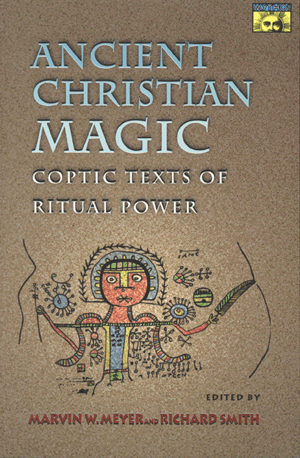
The book is Ancient Christian Magic, Coptic Texts of Ritual Power by Marvin Meyer (Professor, Claremont College) and Richard Smith (Princeton University Press, 1999). The authors go to great lengths to address spells for luck, health, sex, protection and fertility within a context of a culture that swirled in the "ocean of cults and sects that flowed around the Roman Empire," before magic became antithetical to Christian belief. Gnostic sects were a major contributor to the magical beliefs of the times, and early church fathers condemned these sects often for that cause. Gnostic spells for ascending to heaven, incorporating Christian sacramental customs, abound. Likewise, to an early Christian, calling on Isis and Osiris in a love spell would be akin to our use of Romeo and Juliet as paradigms today.

These spells are a religious cacophony! The petitioners call on Mary, Gabriel, Michael, Osiris, isis, Horus, Solomon, Zeus, angels, Adam, Eve, and Egyptian deities I have never heard of from Batha to Harmozel! Such religious motley stew had meaning to the petitioners, who included herbs, oils, incantations and special signs and inscriptions with their words of petition, all to create a spell for a desired outcome. While modern Pagans/Christians try to explain their religious paradigms with great care and often little hope of understanding, the Coptic Christian calmly recited:

"Greetings to the powers!
Greetings, cheubim!
Greetings, seraphim!
Greetings to the twenty-four elders of the heavenly church
and everyone who dwells in it.
Greeting to the shining sun!
Greetings you twelve rulers in charge of the houses of the night.
Greetings Harmozel, the great ruler, gathering together the heavenly and earthly beings. . ."
(spell for a good singing voice, to be recited over a chalice, to Harmozel, with specific recipe for a magical ink to use on the properly prepared papyrus.)


No part of this spell includes an apology for using Christian and Pagan deity.

The spells for sexual attraction and love are great fun to read, and include straight and gay petitions. Here, in a particularly sweet spell, a man begs a magical oil to bring mutual love to his intended:

Oil! Oil! Oil! Holy OIl!
Oil that flows from under the throne of Yao Sabaoth! Oil with which isis anointed Osiris's bones, I call you Oil!
The Sun and Moon call you! The stars of Heaven call you. . . and you must make my love be in her heart and hers in mine (like) a brother and sister, or a bear (who) wants to suckle her young. Yea, yea, I (invoke) you, the one whose head is in heaven, whose feet are in the abyss, before whom is (what) is also under the Sheep, behind whom is (what) is also under Draco, the heaven of all darkness is hung. . .


Here the magical call is for a gay lover:

Celtatalbabal. Nnasknekie, by the power of Yao Sabaoth, ROUS ROUS ROUS ROUS ROUS ROUS ROUS

I adjiure you by your powers and your amulets and the places whre you dwell and your names, that just as I take you and place you at the door and the pathway of Phello son of Maure, (so also) you must take his heart and his mind; you must dominate his entire body:

He must seek me from town to town, from city to city,
from field to field, from regions to region,
untel he comes to me and subjects himself under my feet -
me Papapolo son of Noe
while his hand is full of all goodness,
until I satisfy with him the desire of my heart
and the demand of my soul,
with pleasant desire and love unending,
right now, right now, at once, at once! Do my work!


Sadly, there are no included spells by women to attract sex or love from a man, though the authors mention they exist! (And we girls wanna see them! The authors do not mention if lesbian spells exist; though if they do, we wanna see them, too!) However, there are spells included by women, including spells to stop unwanted male sexual advances:

O binding of the sky,
binding of the earth,
binding of the mountain,
binding of the water,
binding of the ring of the father,
binding of the ax that is in a hand of flesh,
binding with which Christ was bound upon the wood of the cross!

May the present binding be upon the male organ of N. toward N. He must not be able to release the virginity of No; hemust not become hard, he must not have an erection, he must not ejaculate. . . May the flesh of N. be like a corpse; it must not be able to get out of the tomb, yea yea at once!


Spells abound for healing, for sleep, for safe delivery in childbirth, for protection from illness and evil curses, for good luck in business. Some petitions are to silence sleeping dogs, to bring on menstruation, instructions for amulets to bring power.

To a Coptic Christian, spells were a daily part of life. The use of spells, amulets, power oils, magical inks, all sound more today like a Wicce/Pagan/Witch than a typical Christian. Yet in the early Coptic church, magic and Christian worship were interchangeable. Calling to Jesus, Mary and Osiris were common prayers. Asking the assistance of the powers of the earth and the powers of angels was normal. Trying to be a Christian and Pagan wasn't a question - everyone felt comfortable with both - and more.

Obviously I am offering this vision of Coptic spellcasting as an example of how to explore the boundaries of religious expression. Putting together a religious faith should be a path to a faith that nurtures each of us. In no way am I saying that personal religious expression is the be all and end all of faith; helping others and political action remain central. Yet having a personal faith that fits is itself central to finding the inner resources to put that political action out there.

Coptic Christian Spells offer one model of a new way to express multiple layers of faith.

Tuesday, September 7, 2010

Finding Mary Magdalene: the Heinz Chapel


(Mary Magdalene Picture courtesy University of Pittsburg.)


I attended an organ concert at Heinz chapel this past week, my first visit inside the famous Pittsburgh landmark at the University of Pittsburgh. Now the SW Pennsylvania area abounds in Gothic revival architecture, so I had never visited this particular chapel despite dropping my organ-loving daughter there for concerts. So I walked into this chapel rather inured to stone vaults and repeated arches and even Tiffanny windows.

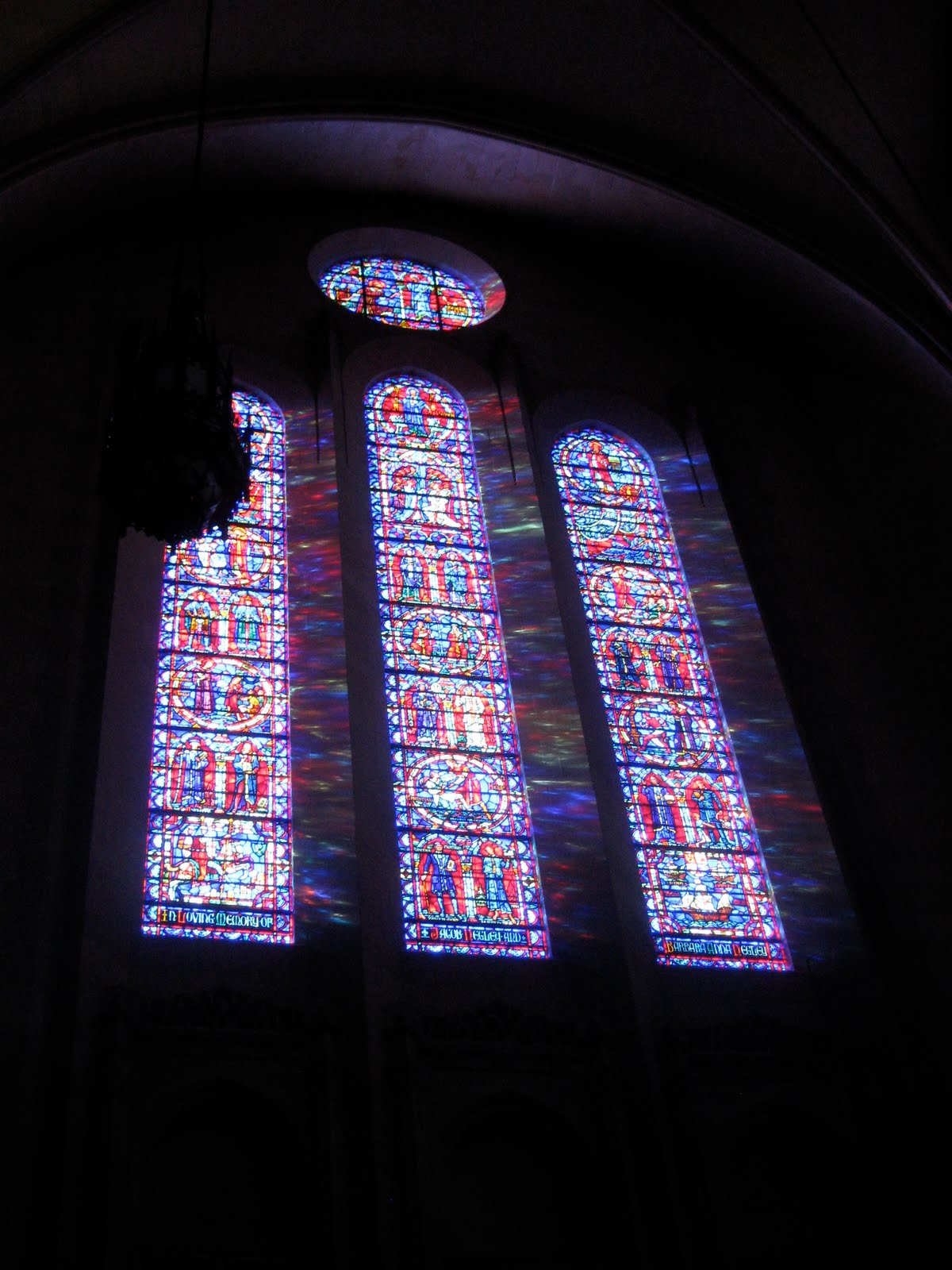
However this chapel was built on a college campus with a college committee choosing the images inside: the result had me gasping and ignoring organ music. (Hey I hear a lot of Bach already. . .) A full fifty percent of the images in the Heinz chapel's stained glass were women. And not just Biblical women - though that would itself be stunning - the Heinz chapel's famous stained glass include Native women (Kapiolani, Kateri Tekawitha, Pocahontas), literary women (Emily Dickenson, Elizabeth Barret Browing), women from multiple denominations (Hannah More and Elizabeth Fry and Saint's Dymphna and Eunice and Clare),and histories (Abigail Adams, Dorothea Dix, Clara Barton, Florence Nightingale). Look carefully and find a small section of window dedicated to the Women's Christian Temperence Union:


(detail of Florence Nightingale)


What also astounded me was the huge window devoted to Saint Mary Magdalene. For many Christian women all over the world, Mary Magdalene has such important significance - as one of the apostles following Jesus. She is one of the most important examples of a woman and teacher in the Jesus movement. She was present at Jesus' death, burial and the first person to see the resurrected Christ. In apocryphal texts she is the "apostle to the apostles." I know Christian women who identify Mary Magdalene with Wisdom, Sophia, the feminine side of Christ, a symbol of women's equality in church and worship, and as an example of the female side of God. All those views are especially valid for those of us sitting in pews every Sunday hearing about God the Father and the Father, Son and Holy Ghost. (Hey I am sick of creator, redeemer, sustainer language as well. . .)

The presence of this huge window in the Heinz Chapel, dedicated to the Magdalene, just awes me. Her window stands equal with the Virgin Mary, with Joseph and with other apostles depicted. Such a physical demonstration of women's equality and the Magdalene's importance is amazing.

Years ago I took an art and religion course at the Pacific School of Religion with the fun and wonderful professor Doug Adams. With Professor Adams, we explored the art of church, what buildings tell us about religion. Professor Adams literally encouraged to explore the PSR chapel by crawling under pews and rolling in the aisles. (None of this was surprising to me as I grew up in Frank Lloyd Wright's First Unitarian Universalist Church in Madison, Wisconsin, where the UU adults left us kids alone and we literally climbed the limestone walls that Wright so carefully designed. . .) Professor Adams wanted us to understand that the visuals of a church teach as much as any sermon.

What does that say for all the churches with pictures of male apostles, male ministers in the hallway, Jesus pictures everywhere, and no women to be found? The overwhelming message is that religion and the divine are male. Whether Christian or Jewish or Muslim, those of us from the patriarchal religions grow up without images of female divine.

The Heinz chapel blew me away because, pagan or christian or Hindu or whatever type of Goddess worshiper I am, I still live unaccustomed to seeing women anywhere in religion. Yet I stood in the Heinz chapel, ignoring the music, to instead see that rarest of things: pictures of women - all types of women - as holy.

Monday, August 16, 2010

Multiracial, anti-racism, and hermeneutics


Time for a long post on delicate topics. Sitting here on my blog is the wonderful button for Caorann, Celts Against Oppression, Racism and Neo-Nazism. A wonderful group they are, and I encourage all to explore any anti-racism group, no matter their religious orientation. Anti-racism work is for all.

At the same time, I live in a decidedly multiracial world, a world still unimagined in progressive Christian and Pagan circles. In my nuclear family, we have 3 of us with African American heritage, two with First Nation heritage, two with Polynesian ancestry, 5 with Celtic/Northern European ancestry, and one with Chinese ancestry. In my extended biological family, add relatives with Asian ancestry. In my lesbigay and adoptive family, add Indian and more First Nation and African American. I am with people of every color and multiple ancestries every day - not forgetting my own African American and First Nation ancestry as well.

The reality of multiracial life is complex. My darker kids face more daily prejudice than my lighter kids. I have dreads, but don't face the discrimination my darker dreadlocked friends face. It is fun shopping with my family and friends, and watching store clerks figure out which of us is the most dangerous and needs the most watching. In a lighter skinned group, storekeepers might follow me. Or they might follow my darker children. The majority of shoplifters in America don't have dreads and aren't dark skinned, but that doesn't stop many shops from being prejudiced.

On the other hand, my lighter kids have been asked to leave monoracial support groups, as their Asian ancestry was too mixed. A local Chinese American youth orchestra refused to give my daughter any music, for example. The administrative head of the orchestra, herself with a mixed race child, apologized and explained that most of the families there looked down on kids with multiple ancestries. My daughter's then advanced Mandarin skills weren't enough to cover her hair and skin color. (For a few years after this, said daughter used to tell me, "Mom, I'll just let people think I'm white." She has moved on from this, with lots of support.)

And back to Caorann. The group does a fantastic job addressing racism and theft in the Pagan community (not that the Christian community doesn't need to listen as well), and Caorann is especially active protesting the theft of First Nation beliefs. Since every pagan magazine across America has ads for "Native American shaman will teach you secret Lakota healing ritual" types, it is especially important to look at cultural exploitation and Paganism. Caorann lists fabulous links, go explore them.

One link I want to submit to some hermeneutical discussion, however. Caorann links to the Celtic Reconstructionist Paganism movement, including it's long FAQ. And in many ways the FAQ is a wonderful document. However, Celtic Reconstructionist Pagans, like so many other groups, have not addressed multiracial families.

I copy a section of the FAQ here:

Can I be CR and still worship non-Celtic deities?

Yes, but with caveats.

Worshipping non-Celtic Deities is regarded as outside the purview of CR, and should in no way be considered a part of CR practice. While it is acceptable for people involved in the CR community to have non-CR practices in their personal lives, it should be kept firmly in mind that they are just that — non-CR practices. The cultures and rites of non-Celtic Deities should be respected, just as we expect Celtic cultures and Deities to be respected, and these rites should be kept separate from your CR practice. If you worship Deities of other cultures, separate altars should be maintained for Them, and offerings and other rites should be undertaken in the ways of that Deity’s culture.

If you feel a particular pull to Kali, for example, it is highly recommended that you worship Her through a local Hindu temple, or at least in traditional Hindu ways, rather than attempting to bring Kali into your CR practice. She is not a Celtic Goddess and would probably resent being treated as such. She already has Her own formulated and traditional rites and practices, Her own preferred offerings, and Her own holy days. To ignore those things in an attempt to fit Her into a CR practice would be doing violence to both CR and Hinduism.

The only times when it might be acceptable to worship non-Celtic Deities in a CR format would be in the cases where long-standing, historical interactions betwen related cultures created a hybrid cultural environment that traditionally included these Deities. For instance, in the cases of some Highland Scotland and coastal Irish communities that adopted some of the Norse Deities and customs. If the cultures had enough similarity, and it is clearly evident that these two cultures did meet and mingle and create an historical tradition, it is often considered acceptable to continue to include these long-standing syncretisms as part of that tradition.


Well, if you've been reading this website for awhile, ya know I've been talking of Kali and Maman Brigitte, as well as Bridget and the Morrigan. The Celtic Reconstructionist Pagans are questioning this, rightly trying to address racism, and wrongly forgetting multiracial people, families and communities.

Why shouldn't someone with African American and Irish ancestry (hmmm, like my daughter) worship Maman Brigitte, Yemaya, and Bridget - all at the same time? Why shouldn't I write of Kali and Bridget, when my own LGBT family includes men and women from India? Why can't my Christian friend, African American and First Nation, hold a shrine to Buffalo Woman and Oya? This question goes back to one of the most fundamental of human questions about self and family. It also harkens to that endless question we bisexual people get about "choosing sides," as if human race or human sexuality is a question of opposing "teams."

I have brought my kids up knowing that it is a violence should anyone ask them to divide against themselves or against their own family. My dear moon sister, African American, womanist, First Nation, proud LGBT ally, mom of an autistic child herself, has run into this "opposing teams" concept her whole life. Activist Blacks will ask her if she is first a Womanist or first an African American. We laugh together about this question (what does she do? Cut out her vagina to be Black? Erase her skin to be Womanist?) It is a violence to ask anyone to ignore their sexual identity OR their racial identity.

Likwise it is a violence to tell multiracial people to choose a team. My kids can identify anyway they so choose: as multiracial, Black, African American, Native American, Polynesian American, Chinese American, Asian American, multiethnic. . . whatever they choose. After all, it is their lives and their bodies.

And no religious tradition should divide anyone from their racial identities either. My youngest has recently decided she wants to be Muslim, Jewish, Christian and also worship Bridget. Well, that is an unusual path, but it reflects her friends and our family. No one has a right to tell her this path is wrong. What the Celtic Reconstructionist Pagans are ignoring is that, well guess what, some of us are inherently syncretic. (By the way, one of my oldest multiracial family friends is a mom in Aberystwyth, Wales, who has African Caribbean and Welsh children. The Celtic world is becoming more multiracial, too. . .)

So by all means, let's as Pagans and Christians and Hindus and Muslims and Buddhists - let's all of address and confront racism. Stealing from cultures who specifically ask us not to is itself racism - whether it's Pagan "Native American cleansing ceremonies" or Christian churches using Dream Catchers to teach vacation Bible school. Some non-Aboriginal person teaching "Aboriginal secrets to dreamtime" is suspicious, as well as some non-native Hawaiian teaching "Hawaiian rune secrets."

But for multiracial people to explore the cultural customs of all our ancestries is a reality of multiracial life. You can't call it syncretic racism, because instead multiple ancestries are our bones, our families, our lives.

Sunday, June 20, 2010

Christian and Pagan? Not so new. . .


I grew up with a Christian Witch.

My great grandmother, always Mamaw to 3 generations of young children, walked paths many women and men are trying to trod today: her love of gardening, people and economic independence meant that at the turn of the 19th century she maintained a midwifery business, a bread baking business, and to the shock of her family, her own bank accounts and book keeping. For the Appalachia of the time, she was a "witch, a woman who helped others through birthing, and that type of witchcraft in no way prevented her active participation in the Green Shed Valley Cumberland Presbyterian Church.

I know of Mamaw mostly through conversations with my extended family. Like all southern families, every quirk and peculiarity of personality must be traced through one's ancestry, and my own independence was usually traced directly back to Mamaw. As was my visage, tendency to know every one of my cousins, and my interest in herbs and gardening, spinning and weaving, and later my interest in theology. "You get that from your Mamaw," was a childhood refrain. That by the 1970's whatever embarrassment Mamaw caused the family had eroded into the feminism of the time was never lost on me. "You are just like your Mamaw," was usually said to me with both exasperation and a certain amount of pride, thank you very much!

On another note, however, Mamaw changed my spiritual life.

The only conversation I remember with her was brief. Her acre sized garden was her pride and joy in her last years, after midwifery had lost out to modern hospitals, and grocery stores replaced delivering bread on mules. On hot afternoons I would sit at my Mamaw's trailer, with her porch covered in roses, clematis and wisteria, while she made tea from her garden. One time, and only once, she had no fresh cut herbs and she allowed me - oh precious and rare treat!, to go into that flowered sanctuary and harvest herbs. She explained to my both solemn and excited self that there was a method to cutting plants.

"All plants have spirit," she explained to me, while I am sure I struggled to convey my understanding. "Just like everything else, you have a spirit; I have a spirit; the trees have spirits; the mountains have spirits. You have to cut the right plant, with the right spirit, to make the right kind of tea." She snipped at mint and lemon verbena while, most honored, I got to watch. "If you want to heal with plants, you have to pick a plant with a healing spirit. To work with any spirits, you have to know your own spirit."

That was it.

She brought the herbs in, and I got to put the scissors away (another rare honor; Mamaw did not share her garden tools), and she went back to her afternoon soap operas. I don't remember any more conversations with her until her death, not more than a year later.

That Sunday, she, as usual, refused to go to church, as she had lifelong arguments with the many ministers that came to the valley, and no one saw that as any lack of Christian belief on her part. Mamaw was famous for her critiques of area ministers, perhaps her best contribution to her little church community. I still hear, 40 years after her death, of stories when she publicly argued with ministers on matters of doctrine and text.

I would, of course, come to love stories of her many theological disputes, as well as her commitment to temperance and her equally famous (and I am told horrifically sweet) blackberry wine. I also learned from her daughter, my grandmother, of how opposed my Mamaw was to integration, Martin Luther King, and the Civil Rights Movement. Mamaw's racism impacted my generation; if not for Billy Graham integrating his television ministry, I don't think my father's family would accept integration to this day.

(Billy Graham, if you are reading this, thank you!)

Yet her introduction of meeting spirits stayed with my young self. From that special time with Mamaw, I started introducing myself to plants and trees and mountains, to lakes and valleys, to creeks and animals, and eventually figured out how important spirit is for people. I still find myself learning who my own spirit is, the better to pick the plants - and every other path - of my life.

Mamaw shows how easy it is to be Pagan and Christian. And she was a critical and loud mouthed Christian at that! (Finest kind, of course!) I find it amazing, when I head to church, or when talking with other pagans, that we still see the Pagan/Christian world as so separate and divided. "How can I worship both Goddess and still be faithful to Jesus?" is a question I hear weekly, and since starting this blog, almost daily!

Well, it isn't that hard, really. Folk traditions of my Appalachian family are easy enough to find for me; yet when I work with people as friend or counselor, I find most of us come from families with traditions and folk ways that lend to a spontaneous and creative spirituality. Goddess and pagan worship abound in Biblical sources, but if cakes to the Queen of Heaven seem remote today, most families come with more recent pagan traditions that just need to be dug out.

My childhood Lutheran friends, of Scandinavian ancestry, all kept trolls and dragons about their homes, for luck and protection. My African American sister grew up with voudou and conjuring, despite a rigidly anti-Pagan Black church. My English friend has a father who danced Morris dances. My Chinese friend learned feng shui from her mother. A friend from Maine had a mom who planted their vegetable garden by moon signs, and my Irish Catholic friends all grew up with saints and prayers and rosaries that I have added, with no ancestral connection, to my own worship. Scratch most any family, and you find paganism. For those of us without Jewish ancestry, that paganism almost always co-existed with Christianity just fine.

Recently a church friend was raving to me about how great my blog is for him, and how he wants to be more fully pagan and Christian, and how great a role model I am. (And thank you for all the compliments very much! They are appreciated!) However I had to admit that, well, however much I seem to be charting new paths, if you look at my family I'm not such a trailblazer as all that.

My Mamaw was a witch and a Christian. No problem. And she lived 100 years ago.


May all these paths be easier for our great grandchildren, 100 years hence.

Sunday, June 13, 2010

The Dark and Playgrounds for the Soul


"You must fight for the light."

Thus starts a book I began last night, one much recommended by church friends - where for the past year a group of parents and I have loosely explored vampire/werewolf fiction, while searching for a positive "Twilight-equivalent" for some of our obsessed daughters. (I am blessed to have a daughter and son who, so far, have found Twilight sacharine and poorly written!) One of the disadvantages of my kindle, however, is that when a book is utterly annoying, one can't just throw an expensive ereader against the wall as one can a cheap paperback. How frustrating!

The book is yet another of these young adult mage/wizard/witch genre, following in the Harry Potter path. And it, like Harry Potter, gives into Western stereotypical and racist visions of magic as "light = good," and "dark = evil." Given that Black liberation theologians have been railing against these themes for several decades, you would think authors who care about social justice - and write for young adults encouraging them to fight against "evil," would erase these racist themes from their novels.

At the same time, in on line conversations with other Goddess worshiping Christians, I have joined in talks about seeing deity as "light" and "against dark." Clearly I oppose this dualism. Between Kali Ma and the Morrigan, and among God and Goddess and deity and the holy - all are ever dark for me, and the dark itself thus sacred. When I light candles for Bridget, I am not fighting back the darkness, and indeed that darkness is as much part of her hearth as any flame is. My candles are lit for the darkness as well.

And little did I know how profound that darkness can be! Spirituality is ever surprising!

I've been realizing today that the dark can be a holy playground. I have ever approached darkness as a place where seeds and life begin, where dreams begin in the night, where hope and aspiration find sustenance. Yet over the past year I have been playing in the dark as well, in many ways exploring pretend play for the first time in my life. That play has been so creative and explosively spiritual, that I remain in utter awe that so much growth is possible from the most simple of childhood games. In my role as an early childhood caregiver for so many years, I have over and over stood up for the importance of play for children, and yet that same play is also good for adults. I have only just learned that.

Such learning is a gift. A friend has written me of his different sides in his role playing game life, and clearly sees pretend play as something that helps him grow. Which leads right back to that playground. The dark becomes more than holy ground and holy sustenance and holy night. Play becomes holy as well.

Defending play as necessary for children is something many parents from every religious tradition are doing. My own school district long ago eliminated recess, and schools all over the country are slashing art, music and science programs. Kids get little play time anymore. Adults, working two and three jobs, get even less. Yet part of the growth all humans need is time to play. Sacred and holy playgrounds have to be maintained.

I think here we find a service pagans do better than many Christians. I think of the rituals I have attended when pagans dress as everyone from the ubiquitous Cerrunnos to Jedi warriors and male and female goth bellydancers. Churches aren't typically places for guys to explore dresses (unless you are a priest or choir member, and then the exploration is far from playful), or anyone to dress in Harry Potter robes. My own church, fortunately, does provide such a playground for children with its wonderful arts and theater program - open to all of every faith. The kids, at least, are dressing up and donning roles and pretend play. Perhaps the long and lasting memories of Christmas church pageants reflect not only the wonder of Christmas, but the joy of dressing up.

In other hats, I often get to talk to other parents whose kids love pretend and dress up. As capitalism forces our kids to be more and more adult at younger and younger ages, I know many parents all over the world who have fought to preserve pretend play and dressing up in safe places for our children. Despite its racism, Harry Potter book release parties long provided my own children with a safe place to dress up (I have compared the many parties for the Harry Potter book releases to superbowl events for readers). Ren faires, science fiction and fantasy fairs, the Society for Creative Anachronism, and pagan and fairy festivals have all figured in my children's life. Clearly, given that adults outnumber kids at most these events, adults need pretend and fantasy as much as kids!

All of these places are playgrounds for the soul. As are online book groups, support groups, RPG games, and plenty of pagan rituals. Finding creativity and play is counter to the goals of human life as profit, and finding that creativity and play can lead to the divine.

So wherever you stand on childhood and adult play, on racist stereotypes in religion and literature, on the soul murder that Western dualisms have fostered on us all, part of religious exploration is embracing the dark. Challenging racism. Embracing the night.

Here I offer my own song, sung for my Sunday School attending kids, and in honor of all their skin colors. I've sung this at church, at pagan circles, to sleepy kids. Take it and share as you see fit.

To the tune of "This Little Light of Mine"

The dark inside of me,
I'm gonna let it grow.
The dark inside of me,
I'm gonna let it grow.
The dark inside of me,
I'm gonna let it grow.
Let it grow, let it grow,
Let it grow.

I used to sing this to my kids, other Sunday school kids, to others exploring religion and anti-racism. I am only just realizing that wow, that dark really is inside of me, and it is wondrous.

It is Gay Pride over in Pittsburgh today! And I keep learning how many, many ways there are to come out! Yet for this pride day, where I've marched as a bi woman and lesbian mom for decades, I think I will march as a child at play in the darkness of God, a new world for me, and a holy one. I pray that whatever dark playgrounds I lose, I will find new ones.

Tuesday, June 8, 2010

Hebrews 13:2 Revisited: No Humans are illegal


I've wanted to re-visit the topic of Hebrews 13:2 ever since Arizona passed an egregious law requiring police to ascertain citizenship status of people in that state. Police across the country oppose the law; anyone concerned with racism opposes the law; the Obama administration is investigating the very constitutionality of the law.

But what about the law and spirituality? Mystic Blue Rose, on her great blog, posted a wonderful piece by a Christian friend of hers that she has given me permission to re-print here:

"I've been avoiding jumping into this conversation, but I think I'm going to just...not debate anything or argue with anyone, but just state a position as far to one side of the spectrum as I can go, and let it be part of the soup. Sometimes I find myself rationally pondering the U.S. immigration issue; and then I say to myself, "Wait a minute...what I really believe has nothing to do with these rational and practical considerations." So here's what I believe at the bottom of my very best heart.

Nations and their boundaries are an utterly human concoction, a development of our tendency to self-centeredness and sin, and are in no way, shape, or form part of the divine reality and divine goal for the human race revealed in Jesus Christ. God did not create a world of nations. Jesus did not die and rise for this or that nation. The church from its very beginning knew no national boundaries, welcomed people of all nations, and has been and is a trans-national body owing allegiance to no nation on earth. A Christian is a member of the human race whose allegiance to God through Jesus Christ is untainted by allegiance to any human entity. A truly Christian response (you can tell a truly Christian action because it has a fair chance of being fatal) ... a truly Christian response to immigration would be to stand at any border anywhere on earth, and lean across it and say, "Is there anything I can do for you?"

I believe I'll stop there. That sounds sufficiently breath-taking in its arrogance and naivete -- or, perhaps, sufficiently childlike in its simple-minded devotion to the One who made, redeemed, and cherishes all human life, and all creation. Again, this is not meant to be an argument against anyone else's position. I doubt that I think and act consistently with this myself all the time (another test, in my own mind, for when something is true!). I'm just putting it out there.

Peace and blessing,

David R."


Thank heaven, many have Christians have followed David R.in asking similar questions, and most Christian denominations across America are vehemently against Arizona's law.

I am going to assume most Pagans are, too, though I have seen less on-line from Pagan viewpoints. I expect Starhawk, intrepid political witch that she is, to speak out with her Reclaiming group (sometime soon remind me to re-print her anti-racism statement on here); I know that LGBT Pagans have also spoken out. Yet in keeping with my former post, I want to encourage everyone, regardless of spiritual orientation, to ask how one can host angels unawares if we treat other humans as legal or illegal?

And I want to add some fact to the discussion (something rarely seen in newspapers around the country right now. . .)

FACTS:

"This data, compiled independently by both the F.B.I. and the University of Colorado-Boulder shows that, contrary to political rhetoric from the right, immigration, and even illegal immigration, does not make communities more dangerous. The research, which appeared in a peer-reviewed paper in the June 2010 issue of Social Science Quarterly, specifically avoids mistaking correlation for causation, instead providing the most compelling data to date to back up claims that the anti-immigration sentiment in this country is rooted not in fact but simply in fear.

The data is even more compelling than simply rebutting the ideological argument that immigration is connected to crime. The evidence suggests that immigration appears to make the cities immigrants call home safer. According to Harvard sociologist Robert J. Sampson, that's because immigrants often move into neighborhoods abandoned by locals and often have tighter family structures which can stabilize urban neighborhoods on the brink.

And a crack-down in immigration may just have the opposite effect, much to the dismay of SB 1070 supporters. Law enforcement officers like Los Angeles Police Chief Charlie Beck notes that when immigrants fear being arrested for immigration offenses they stop cooperating with law enforcement. These communities will withdraw further into themselves, making those immigrant ghettos ripe for exploitation and abuse and further marginalize, rather than integrate, immigrants into the American experience. Not only does this make getting information more difficult for law enforcement, it increases the amount of crimes law enforcement needs to respond to."
Care2Causes

Welcoming angels means welcoming immigrants, who actually improve our country. Since most of us are immigrants, you would think we as USA citizens could make the connection. (I keep writing letters to the editor asking the so many vocal opponents to amnesty just how many of their families had greed cards from the Wampanoag??)

And welcoming angels unawares, means allowing angels access to all doors. At the least, I hope anyone following Bridget - she who welcomed all to her hearth - will write their newspapers or call their representatives, and demand the country repeal Arizona's law.

Saturday, June 5, 2010

Brand Free Religion


I finally took the kids to see one of our oldest family friends, a conservative, Republican, Southern Baptist family we met in Campfire Scouts - the first scouting organization in the US that welcomed gay and lesbian families, by the way. Our friends from scouting moved two years ago, down to Virginia and the gorgeous Shennendoah Valley, and after two years they are still searching for a church home.

Now I thought a conservative family would find it easy moving to Virginia, home of Jerry Falwell, fox hunting, and a recent election wherein the Governor declared the entire northern part of the state "unvirginian." But no.

Of course, family friends of mine have to be somewhat, um, inclusive, to put up with my alternative family and life. Even more, the two home schooled girls in the family both plan careers in science - marine biology and microbiology/archaeology respectively. As home schoolers, they can indeed plug right into the right wing Christian home school groups in Virginia, but, given their goals, they don't want to. Christian kids planning science careers, outside of Liberty University or Bob Jones University, need a grounding in modern science including evolution. So these kids and their parents found themselves shut out of right wing Christian home school culture. (Not to mention my wonderful friend's rant to the group for declaring women's role in marriage to be one of obedience and assistance to the hubby. You go girl!)

So during our visit, mom and dad and both girls talked with all of us about finding a church home. With their eldest in Iraq, they need some place for spiritual support, and were thinking about investigating some churches outside the Southern Baptist world.

And I encouraged them to do so as well. And I advised them to forget about brand.

At some point, church is about a specific community that can support you and your needs. For this family, they need support for a planned adoption, support for their daughter's career goals, and support for being a feminist family with strong daughters (and one strong mom). In addition, they need a place to feel connected with the holy, to feel accepted for their views on baptism and faith, and a place where they can be accepted for home schooling.

It is impossible to pull these things from any denominational hat. Whatever doctrinal messages a denomination posits, each congregation has its own culture, and you can't find a supportive faith by looking at faith statement alone. So I encouraged my friends to ignore pesky things like denominational label, and to visit churches until they found one they felt matched their needs.

In many ways, this is comparable to shopping in a store. Name brand labels at Costco can help one find a good product, but not always. Generic labels can be good, too. Trying a new brand can be a good thing.

Religion in America is much the same. Over the years I have attended Unitarian Universalist churches (no longer possible for my multiracial family, given the overall white supremacy of UU churches), the Society of Friends (again a very white choice, that is no longer an option with my kids), the Methodist church, and now happily attend a wonderful Presbyterian home.

On the pagan side, I've been to Dianic covens, mixed race Wicce groups, neo-Celtic groups, African American voodoo groups, and shamanic groups. Of late, thanks to this blog, I've been asked to some wonderful druid and Celtic Christian groups as well. All have had their plus and minus sides, and so far not one has been a group that fits my whole family. I know of few local groups with a weekly pagan children's program, for example.

So I keep shopping around.

Because after all, whatever the religious brand, it is the people who make a church or group. Unitarian Universalists talk about tolerance, but I don't think they would happily welcome my Southern Baptist friends! Dianic groups, likewise, have objected pretty vocally to my dating men. I know other pagan groups who have been unhappy when I date women. Sigh. Obviously Christian groups weigh in on the affectional orientation stuff, too.

If you, like I, have a multiracial family, you then add another layer of spiritual needs. I attend churches that have adults of color in leadership positions, a must for my children. My Southern Baptist friends don't need a multiracial church, but they do need one comfortable and aware of adoption issues. (It is so annoying to send one's child to Sunday School, and have them talk to the children about their "real parents" as being "birth parents." Yet it happens all the time.) My Southern Baptist friends need acceptance for home schooling, as well.

My advice to everyone is to visit around. Churches, covens, synagogues, spiritual support groups, temples, mosques and the like all depend upon the people who attend them to shape their culture. Worship times, adult and children's programs, political activism, acceptance of diversity, heck, even something like accessibility for a wheelchair are all going to determine if a religious group meets your needs. Name brand alone won't identify any of those needs, and only visiting will.

My Southern Baptist friends, actually, were fairly aware where they wanted to worship and find community: "Do you think we can go to a Catholic church?" was a question almost all asked me at one time or another. That may seem a surprising choice for Southern Baptists, but for this family it made sense. The Catholic church in their area had devout Christianity, plus an open view of learning science and evolution. That may be the only choice my friends find. As the mom pointed out to me, she can still keep their family views on baptism in all of their hearts, and still find worship and community in a different doctrinal package. And why not?

I encourage people to go to church/coven/synagogue/mosque/temple/cove/group. Building concrete religious structure is necessary if anyone is going to go seeking and find those faiths you hold dear. Sometime you may need that same group when you have a child in Iraq, are adopting a child, going through a crisis, needing a group in your faith search. Just as you need, for your own spiritual growth, to do the same supporting for others.

But brand doesn't have to define your group. I know pagans attending church all across 3 continents, and I know Christians attending pagan groups on 2 continents. I have Jewish friends attending church and Christian friends attending synagogue. And of course I do, since I like my religious happily mixed up in a doctrinal stew.

But if you are searching for a religious home, that is my bottom line advice. Find giving people and go attend there.

The best religious brand is a loving one.