Showing posts with label grandmothers. Show all posts

Sunday, January 23, 2011

Finding Angels


It has been a momentous few weeks. I've been to the ER with shortness of breath and a tight chest and a PCP telling me I had to ensure that it wasn't a heart attack. (It wasn't.) Yet during the 24 hours there, I met some wonderful women, all who reached out and supported me while I watched my blood pressure shoot up and scared the crap outta me!

Then two weeks later, I hit a patch of ice, went tobogganing in my van with no control over where we went, and with two kids in the car, hit a 20 foot wall in rush hour traffic. For several scary minutes we sat in traffic as we watched other cars hit the same ice and slide towards us. Then, while I yelled for help on 911, a tow truck pulled up behind us, blocking us from what would end up being a 6 car pile up - plus the car who hit the ambulance that came on the scene. Of all the cars there, mine and one other were the only ones without serious injury. That tow truck kept the following car pile-up from plowing into us.

So I am feeling pretty blessed these days, and very aware that angels come in all sizes and packages. Angels include Miss Anita and Miss Laverne, two wonderful ladies in the ER with me - both mothers and grandmothers. We sat in the waiting room for our stress tests (I passsed with flying colors), and we talked of all the children who need us. Miss Anita reared two daughters, both gifted, both successful Black businesswomen today. Her children, like my own, were in music and church choir. Miss Laverne, in addition to her own grandchildren, volunteers at her church's afterschool program, as do I. We only shared part of a scary day together, and like me, both ladies were released to go home. Yet we sat there in the hospital urging one another to take care of ourselves as well as all the children in our lives. I promised to do more yoga; Miss Anita is going to try to give up smoking again (the more you quit, gentle readers, the more you quit); Miss Laverne promises to start doing exercises for her back.

Miss Anita and Miss Laverne are wonderful reminders of what is missing in the church: caretaking for those of us caretakers. I go to church and hear the same sermon about learning to be selfless week after week and year after year. Male ministers still talk about humbling ourselves to God, while making more money than I ever have. Yet in the hospital, angels like Miss Anita and Miss Laverne do the real ministry; they told me repeatedly to take care of myself for my own sake and for my children. They shared a gospel that reminds those of us who humbly serve that we matter, too. When I got the all-clear to go home (with a scrip for antacids), I hugged Miss Laverne and Miss Anita good-bye. They are my angels.

And sometimes, tow trucks are angels. Yes, the tow truck came to give me a tow after the accident, but it showed up before any emergency vehicle. By parking behind me, the subsequent pile-up of cars missed me, and I was the only car at the scene who neither hit anyone nor was hit. After the police cleared us to leave, and the ambulance personnel checked out my children, I hugged the tow truck driver (poor guy!). And I've been reminding everyone that angels can be surprising things - grandmothers, certainly. And tow trucks as well.

I have been brought up to listen to grandmothers; many grandma's out there have added to my life. Finding angel grandmothers in the ER was no surprise, but still a blessing. But for the rest of my life I'm gonna see tow trucks, and remember how they are angels, too.

Who knew? All of creation is holy, and we all can serve. Remember, the next time you see that truck driving down the road.

Thursday, July 22, 2010

Crochet for Bridget: Save the Ocean


All crafts are sacred to Bridget, and I have always had a connection to Her through my artwork. I was weaving and spinning (mostly for my barbie dolls) way back in elementary school, and my 1974 sewing machine is one of the proudest purchases in my life (earned by babysitting back in the day, for 50 cents an hour!) Every craft project, from a pie in the kitchen, to sewing patches on jeans, to building an arbor for your garden, to knitting a shawl - all are sacred creations blessed by Bridget.

(I love the word craft itself. Craft encompasses meanings of skill, cunning, intelligence, going back to old high german "kreftig," and old english "craeftig." Crafts require intelligence and skill. Craft itself, of course, is another word for witching. . .)

Crochet, however, can do more than show your skill. Crochet can help save the ocean.

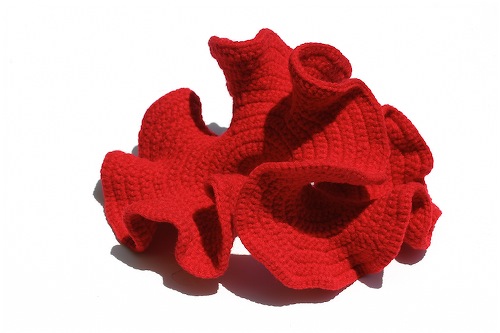
A Cornell mathematician was trying to use paper to demonstrate hyperbolic space to her advanced math students, and couldn't get paper to work. So as a crafter (intelligent and wily), Dr. Daina Taimina pulled out her crochet needles and found the perfect medium to demonstrate how in moving away from a point all the surrounding space expands exponentially. Turns out, crochet was perfect for this - as any crochet crafter can tell you from all of us knowing what happens when you add an extra stitch without noticing! Turns out all us crocheters were doing advanced math all this time.

Crochet is perfect for demonstrating hyperbolic space and hyperbolic organisms in the plant world (like lettuce, for example). Two women at the Institute for Figuring, Margaret and Christine Wertheim, realized that hyperbolic crochet was perfect to model the growth of coral reefs. Given how endangered reefs are at the moment from climate change and pollution, the two women realized this hyperbolic crochet was a wonderful way to show landlubbers what reefs are, and how they grow. Thus was born the crochet project: The Hyperbolic Crochet Coral Reef. The two women started their reef in their living room; today it has grown around the world, with sub-reefs, museum displays, and a huge trash reef installation made from beach garbage and yarn. Like coral, and hyperbolic space, the reef project has also grown exponentially.

And you can participate. The basic reef pattern is here. The Institute for Figuring has its own online website for both crochet and hyperbolic plane information here. Pics of various crocheted hyperbolic coral here (way cool, too!)

And for newbies, some crochet links:

Learn to crochet

Learn to crochet videos

If you live near a JoAnn Fabric Store, there are often really good and cheap crochet classes and help available there (where I go when I'm stuck on a project!)

And remember how valuable crafts are next time you are scrapbooking or baking a cake or sewing for your kids. Crochet, that much maligned craft of doilies and granny squares, turns out pretty important. I think of my many crocheting great aunts, all of whom never went to college, and who always felt themselves uneducated, and who were unknowingly creating models of mathematical space on their front porches through long summer nights. So many of us have grandmothers and great aunts and great grandmothers who, without any college, created universes of hearth and home with their hands and needles, their spinning wheels and cooking pots, their loving hearts and crafty minds. The feminist belief that all women are thus witches stems from this truth.

So whatever your religion, go and honor the earth and Bridget. Try a little crocheted exponentially growing hyperspace. Let's keep creating this world, from great aunts' porches, to a saved coral sea.

Sunday, June 20, 2010

Christian and Pagan? Not so new. . .


I grew up with a Christian Witch.

My great grandmother, always Mamaw to 3 generations of young children, walked paths many women and men are trying to trod today: her love of gardening, people and economic independence meant that at the turn of the 19th century she maintained a midwifery business, a bread baking business, and to the shock of her family, her own bank accounts and book keeping. For the Appalachia of the time, she was a "witch, a woman who helped others through birthing, and that type of witchcraft in no way prevented her active participation in the Green Shed Valley Cumberland Presbyterian Church.

I know of Mamaw mostly through conversations with my extended family. Like all southern families, every quirk and peculiarity of personality must be traced through one's ancestry, and my own independence was usually traced directly back to Mamaw. As was my visage, tendency to know every one of my cousins, and my interest in herbs and gardening, spinning and weaving, and later my interest in theology. "You get that from your Mamaw," was a childhood refrain. That by the 1970's whatever embarrassment Mamaw caused the family had eroded into the feminism of the time was never lost on me. "You are just like your Mamaw," was usually said to me with both exasperation and a certain amount of pride, thank you very much!

On another note, however, Mamaw changed my spiritual life.

The only conversation I remember with her was brief. Her acre sized garden was her pride and joy in her last years, after midwifery had lost out to modern hospitals, and grocery stores replaced delivering bread on mules. On hot afternoons I would sit at my Mamaw's trailer, with her porch covered in roses, clematis and wisteria, while she made tea from her garden. One time, and only once, she had no fresh cut herbs and she allowed me - oh precious and rare treat!, to go into that flowered sanctuary and harvest herbs. She explained to my both solemn and excited self that there was a method to cutting plants.

"All plants have spirit," she explained to me, while I am sure I struggled to convey my understanding. "Just like everything else, you have a spirit; I have a spirit; the trees have spirits; the mountains have spirits. You have to cut the right plant, with the right spirit, to make the right kind of tea." She snipped at mint and lemon verbena while, most honored, I got to watch. "If you want to heal with plants, you have to pick a plant with a healing spirit. To work with any spirits, you have to know your own spirit."

That was it.

She brought the herbs in, and I got to put the scissors away (another rare honor; Mamaw did not share her garden tools), and she went back to her afternoon soap operas. I don't remember any more conversations with her until her death, not more than a year later.

That Sunday, she, as usual, refused to go to church, as she had lifelong arguments with the many ministers that came to the valley, and no one saw that as any lack of Christian belief on her part. Mamaw was famous for her critiques of area ministers, perhaps her best contribution to her little church community. I still hear, 40 years after her death, of stories when she publicly argued with ministers on matters of doctrine and text.

I would, of course, come to love stories of her many theological disputes, as well as her commitment to temperance and her equally famous (and I am told horrifically sweet) blackberry wine. I also learned from her daughter, my grandmother, of how opposed my Mamaw was to integration, Martin Luther King, and the Civil Rights Movement. Mamaw's racism impacted my generation; if not for Billy Graham integrating his television ministry, I don't think my father's family would accept integration to this day.

(Billy Graham, if you are reading this, thank you!)

Yet her introduction of meeting spirits stayed with my young self. From that special time with Mamaw, I started introducing myself to plants and trees and mountains, to lakes and valleys, to creeks and animals, and eventually figured out how important spirit is for people. I still find myself learning who my own spirit is, the better to pick the plants - and every other path - of my life.

Mamaw shows how easy it is to be Pagan and Christian. And she was a critical and loud mouthed Christian at that! (Finest kind, of course!) I find it amazing, when I head to church, or when talking with other pagans, that we still see the Pagan/Christian world as so separate and divided. "How can I worship both Goddess and still be faithful to Jesus?" is a question I hear weekly, and since starting this blog, almost daily!

Well, it isn't that hard, really. Folk traditions of my Appalachian family are easy enough to find for me; yet when I work with people as friend or counselor, I find most of us come from families with traditions and folk ways that lend to a spontaneous and creative spirituality. Goddess and pagan worship abound in Biblical sources, but if cakes to the Queen of Heaven seem remote today, most families come with more recent pagan traditions that just need to be dug out.

My childhood Lutheran friends, of Scandinavian ancestry, all kept trolls and dragons about their homes, for luck and protection. My African American sister grew up with voudou and conjuring, despite a rigidly anti-Pagan Black church. My English friend has a father who danced Morris dances. My Chinese friend learned feng shui from her mother. A friend from Maine had a mom who planted their vegetable garden by moon signs, and my Irish Catholic friends all grew up with saints and prayers and rosaries that I have added, with no ancestral connection, to my own worship. Scratch most any family, and you find paganism. For those of us without Jewish ancestry, that paganism almost always co-existed with Christianity just fine.

Recently a church friend was raving to me about how great my blog is for him, and how he wants to be more fully pagan and Christian, and how great a role model I am. (And thank you for all the compliments very much! They are appreciated!) However I had to admit that, well, however much I seem to be charting new paths, if you look at my family I'm not such a trailblazer as all that.

My Mamaw was a witch and a Christian. No problem. And she lived 100 years ago.


May all these paths be easier for our great grandchildren, 100 years hence.

Saturday, March 27, 2010

A Hermeneutics of my Grandmother


Hermeneutics is teasing out the meanings in history.

The process of passing on history conveys meaning in and of itself, adding a layer to the original story. When we tell our history, we are creating ourselves. Creating ourselves is the ultimate in religious action. Whether we embrace Mary, Mother of God, or Bridget Saint or Goddess, or Durga, or Judith, or Kali or a Raven deva, we are participating in, passing on, and continuing story.

I am going to offer a hermeneutics of my grandmother, who died one year ago today at the age of 101. Her life offers so many stories, and what I tease out to share will say as much about me as her own life said about her. She was never much for talk, my grandma, but I think she would be pleased I tell her stories.

My grandmother, pictured above, was one of the meanest women I have ever known.

She was overtly mean, saying nasty things about others behind their backs, and nasty things to their faces. She said awful things to her grandchildren. High on the list were her endless insults about any of our looks: I was too fat, my nose was too "indian" as was my straight as nails hair (she actually preferred my dreadlocks by the end of her life), I should have worn make up and shorter skirts, and my skin was too dark and "tawny." She pointed out every pimple to my brother and sister, who had severe acne, often pushing them to tears. She called my redheaded cousins "carrot top," also reducing them to tears.

To others she would flat out say, "that dress makes you look ugly," or "you have gotten far too fat since having a baby." She, of course, couched her mean mouth in terms of Christian piety: "I am just telling the truth as all good Christians should." That piety caused adults to cry.

Grandmother was a buttress of her Presbyterian church, a Sunday school teacher for over 50 years, a head of the women's committee, a famous cake baker for church bake sales (her coconut cream cake was justly famous). Her nasty mouth was accepted, as are many traits in the south, with shakes of the head, tsk's, and the ubiquitous "bless her heart."

Partly my grandmother was tolerated due to her very hard life. My grandfather was known for his violence throughout 3 counties. Neighbors and relatives used to tell stories of my grandfather's temper, not with Christian indulgence, but with worry and horror. Such an attitude says much in and of itself. When I complained of my grandmother, my many aunts and uncles and adult cousins (and this being the south, second cousins and cousins once and twice removed) often told me to be kind to her, given how hard her life was, and how much she did.

Ultimately, most people came to admire my grandmother. I sure did. The picture above was taken in 1930, one year after marriage and the birth of my father and the purchase of a family farm that required a mortgage just 6 months before the depression began. My aunt and my father grew up in a house with no electricity, no running water, and replacement shingles for the roof were made with tin cans. The mortgage would be a chain on the family until 1936, when by selling every possible scrap of food from the farm, my grandmother paid the mortgage off out of her "pin money." That pin money then went into a jar, where it grew alongside my grandmother's profits from sewing for neighbors and family. She would send both her son and daughter to college, the first in her family to ever do so.

By the time I was born, my grandmother had pulled her family by the skin of her teeth and sweat of her brow into the middle class. Plumbing arrived during WWII and electricity before my birth. My grandmother, who hated the farm and farming and rural America, continued her sewing business, something she loved. Her own dream, to someday own a small dress shop in a neighboring town, was replaced with a small sewing business from home. Despite her mouth, 3 generations of East Tennessee girls grew up with my grandmother's Easter dresses, prom dresses, and wedding dresses.

She taught me to sew when I was 12, and my own ETSY craft business owes everything to her. Growing up and hating visits to that austere and oppressive home, I had escaped to the barn (also pictured above) or back porch, and had taught myself both spinning and weaving on the old "junk" grandma had left from her own childhood. (Grandma eventually burned both spinning wheel, c. 1840, and barnloom, c. 1820, for firewood. My aunt and I had to rescue Grandma's home sewn quilts from the fire as well.) The tools my grandmother hated as part of a rural past she never escaped, were for me windows into a historical world of women spinners and weavers. I started using spinning spells by the time I was eight.

My grandmother, stern and stalwart member of her church, hated folk religion. Her mother, always called Mamaw to my generation, had run an illicit liquor business selling homemade brandies from the herbs in her garden, and embarrassing my grandmother throughout prohibition. No one, by the way, ever tried to close down my great grandmother's wines and brandies! For my grandmother, having a famous mother who used herbs, alcohol, bread and folk midwifery to maintain a home business (and her own bank account), had been a source of great shame. My great grandmother, also a staunch Presbyterian - and temperance worker, used the name witch as a Christian without compunction. My own grandmother, with her famous sewing business, refused having her own bank account throughout her life.

Of course I am made of them both, and their lives were ever focused on building, creating, saving what they could, finding their own strength and independence wherever they could, and in their hands they created and passed down all that love and strength to me. I did not attend my grandmother's funeral last year. My daughter was receiving an award for her piano playing the same day as the funeral, and every single member of my family told me quite sternly to go to the award ceremony with my daughter. "That is what your grandmother would have done," they all said. I believe they are right.

So who is my grandmother? A battered woman with a horrific and violent husband? A fervent and loving Christian wife? A devoted and selfless mother? An impoverished proletarian worker? A strong and courageous woman who wrestled what she wanted from life as best she could? She herself, by the way, would pooh pooh such questions and this article. "There is work to be done," was one of the many things she said, over and over, every day, and of all that anyone remembers of her, that is probably the one thing she said most. For 101 years she was up at dawn, and in bed by 10:00. Not a day went by without her washing a floor, feeding the barn cats, or baking biscuits.

The stories told about my grandmother represent alternate religious paths. Her funeral, at the Presbyterian church in Fall Branch, Tennessee, included a fairly normal sermon about my grandmother and her work in the church. No mention of my violent grandfather, my grandmother's lifelong business and efforts to put her children through college, no mention of her lifelong dream to own a dress shop. The sermon did include her Sunday school teaching and works in the church. The minister didn't mention her coconut cake.

My father, who loves his mother still, often tells of her hard work, especially the gardening that kept him alive during the depression. He will not discuss his own father at all. When my aunt talks of my grandfather's violence, my dad will ever try to shut her up. Not interested in women and sewing, my dad never mentions my grandmother's creativity. He was, however, proud of her work before she married, when my grandmother for a few short years had lived in Elizabethton and worked for a textile mill.

A seed collector, my dad still grows plants from his mother's garden.

I tell about my grandfather's violence. I grew up under strict orders to never allow my sister or any other grandchild near him alone. I also tell of my grandmother's sewing business, though I am the only one of her grandchildren to learn to sew, to later work in a textile mill myself, and to have my own quilting/spinning/weaving business. I'm also the only one of my family to talk of my grandmother and great grandmother as businesswomen, as artists, as fiercely religious women. I am the only one in my family to keep that picture above.


We can approach religious puja, and worship as women, the way I have approached my grandmother. To put it mildly, my grandmother's endless comments about my looks were hurtful. I could have left my relationship to her with those undeniably cruel stories. Teasing out religion as women, we - whether pagan, Christian, Hindu, Jewish, Islamic, Wiccan, Buddhist, Celtic, New Age, - have to weed through equally hurtful stories of oppression.

However, if I had kept to the surface stories about her, the stories from her own church and from my dad, I would have lost my grandmother who saved the family farm and sent her kids to school, and I would have lost the grandmother who dreamed of a dress shop, and who dreamed of design. If I had kept to my grandmother's own words, I would have lost her completely as well, since her own words were often cruel or cliche. If we let others choose our stories and the meanings there, we lose our grandmothers and we lose ourselves.


Instead I am blessed. I am a talker, and I ask questions. I taped my many relatives' stories when I was younger, hearing about my grandmother from the many women who wore her clothes. I questioned my grandmother as well, taped her, too, and when I was older told her she was too often cruel. (She was surprised. I now wonder if she had no idea how others heard her mean insults.)

I had my grandmother show me her treasure box one day, which had her wedding ring grown too small, some pearl earrings, and the canceled mortgage from 1936. She never threw that mortgage away. I was 14 when she showed it to me, and even then I understood it was a paper of deep importance.


So there you have a hermeneutics of my grandmother. I encourage everyone to go hermeneutic their own family stories. You may find scraps of paper with the essence of your relative. In the finding we are all richer.